The Best Pineapple Upside Down Cake Recipe That Will Steal the Show
There is something deeply nostalgic and joyful about a pineapple upside down cake recipe. The first time I made one — really made one, from scratch, not from a box — I remember the exact moment I set the warm cake pan on the counter, took a breath, and flipped it over onto my grandmother’s old floral cake stand. I held my breath for a long two seconds. And then there it was: golden caramelized pineapple rings, jewel-bright maraschino cherries gleaming in every ring, the whole thing glazed in a deep amber brown sugar sauce that dripped slowly down the sides. My kitchen smelled like a tropical dream and a Sunday afternoon all at once. I was completely hooked.
That experience ruined boxed mix pineapple upside down cake for me forever — in the best possible way. Because once you taste the real thing, there is simply no going back. This from-scratch pineapple upside down cake recipe is soft, buttery, and moist, with a pillowy crumb that soaks up all those gorgeous caramelized juices from above. It is the retro classic that never goes out of style, and today I am going to walk you through every single step to make sure yours turns out absolutely perfect.
What Makes a Pineapple Upside Down Cake So Special?
The genius of pineapple upside down cake lies in its inside-out construction. You build the beautiful caramelized topping at the bottom of the pan, pour the cake batter right over it, bake it all together, and then — in a moment of pure kitchen theatre — you invert the whole thing onto a serving plate. What was the bottom becomes the crown. What was hidden becomes the star of the show.
This technique dates back to the early 1900s, when cast iron skillets were the dominant kitchen vessel and cooking on the stovetop was the norm for cakes. The modern version exploded in popularity in the 1950s and 1960s, fueled by canned pineapple becoming widely available and the iconic Dole pineapple recipe contest that was published in countless American magazines. Decades later, this cake still brings people to the table with the same enthusiasm it did back then.
Ingredients for the Classic Pineapple Upside Down Cake Recipe
For the Caramelized Pineapple Topping
- ¼ cup (4 tablespoons / 56g) unsalted butter, melted
- ½ cup (100g) packed light or dark brown sugar
- 8–10 pineapple rings from 1 can (20 oz) of sliced pineapple — reserve the juice
- 15–20 maraschino cherries
For the Buttery Cake Batter
- 1½ cups (177g) cake flour, spooned and leveled
- 1 teaspoon baking powder
- ¼ teaspoon baking soda
- ½ teaspoon salt
- 6 tablespoons (85g) unsalted butter, softened to room temperature
- ¾ cup (150g) granulated sugar
- 2 large egg whites, at room temperature
- ⅓ cup (80g) full-fat sour cream, at room temperature
- 1 teaspoon pure vanilla extract
- ¼ cup (60ml) reserved pineapple juice, at room temperature
- 2 tablespoons (30ml) whole milk, at room temperature
A few important notes on ingredients before you begin: Use cake flour, not all-purpose flour. Cake flour is finer and produces a dramatically softer, more tender crumb — especially important here because the weight of the fruit topping compresses the cake beneath it as it bakes. Full-fat sour cream adds moisture and richness that you simply cannot replicate with low-fat substitutes. And make sure every refrigerated ingredient is genuinely at room temperature before you begin — this ensures the batter emulsifies properly and bakes evenly.
How to Make the Perfect Pineapple Upside Down Cake — Step by Step
Step 1: Preheat Your Oven
Preheat your oven to 350°F (177°C). Position a rack in the center of the oven. Place a baking sheet on the rack below to catch any juices that may bubble over the edge of the pan during baking — this is not a disaster waiting to happen, just a delicious one.
Step 2: Build the Caramelized Topping
Pour the melted butter into an ungreased 9-inch round cake pan or 9-inch deep pie dish (at least 2 inches deep). Tilt the pan to coat the sides with butter. Sprinkle the brown sugar evenly over the butter — every corner and edge matters here.
Now, very important: pat the pineapple rings and maraschino cherries dry with paper towels. Excess liquid is the enemy of a beautiful, caramelized topping. The wetter the fruit, the more likely the topping will turn soupy rather than glossy and caramelized. Arrange 6 to 7 pineapple rings in a single layer over the brown sugar. Halve 3 more rings and press them around the edges of the pan. Tuck a maraschino cherry into the center hole of each ring and scatter the remaining cherries in the gaps.
Slide the pan into the refrigerator while you make the batter. This helps the topping set slightly in place so the cherries and pineapple do not shift when you pour the batter over them.
Step 3: Mix the Dry Ingredients
In a medium bowl, whisk together the cake flour, baking powder, baking soda, and salt. Set aside.
Step 4: Cream the Butter and Sugar
Using a stand mixer fitted with the paddle attachment, or a hand mixer with a large bowl, beat the softened butter on high speed for about 1 minute until smooth and creamy. Add the granulated sugar and beat on high speed for 2 full minutes until the mixture is pale, fluffy, and visibly increased in volume. Scrape down the bowl as needed.
Step 5: Add the Wet Ingredients
On high speed, beat in the two egg whites until fully incorporated, about 45 seconds. Add the sour cream and vanilla extract and beat again until combined. The mixture may look slightly curdled at this point — that is perfectly fine. It will come together once the dry ingredients are added.
Step 6: Combine and Finish the Batter
Pour the dry ingredient mixture into the wet ingredients. Turn the mixer to low and slowly drizzle in the reserved pineapple juice and milk as the mixer runs. Beat on low just until everything is combined and no streaks of flour remain. Do not overmix — this is what keeps the crumb tender. If needed, give the bottom of the bowl one final stir with a rubber spatula to incorporate any unmixed bits. The batter will be thick but pourable.
Step 7: Assemble and Bake
Retrieve the topping from the refrigerator. Pour the cake batter over the arranged pineapple and cherries and use an offset spatula to spread it into an even layer, making sure to cover all the fruit without disturbing the arrangement underneath.
Bake for 43 to 48 minutes. Halfway through baking — around the 22-minute mark — tent a piece of aluminum foil loosely over the top of the pan to prevent the surface from overbrowning before the center has fully cooked through. The cake is done when a toothpick inserted into the center comes out with just a few moist crumbs.
Step 8: The Grand Reveal
This is the moment you have been waiting for. Remove the cake from the oven and let it cool on a wire rack for exactly 20 minutes — not less. Do not rush this. The topping needs time to firm up slightly so that when you invert the cake, it holds its shape rather than sliding off in a pool of hot caramel.
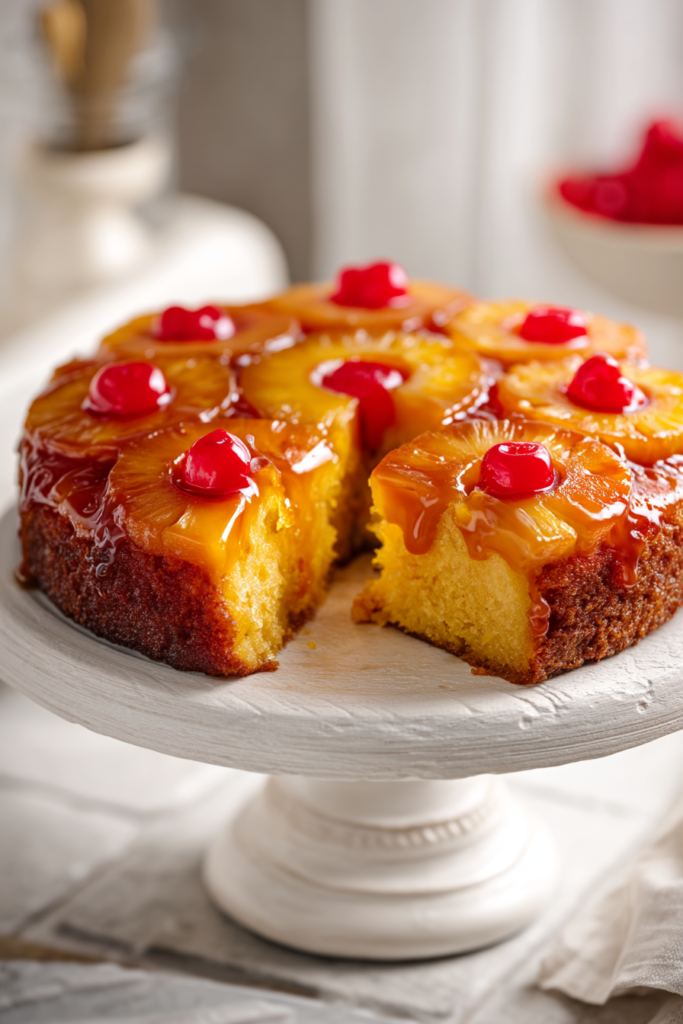
After 20 minutes, run a thin knife around the edge of the pan to loosen the cake. Place your serving plate or cake stand upside down on top of the pan. Holding both the pan and the plate firmly, in one confident motion, flip the whole thing over. Wait 10 seconds, then slowly lift the pan away. The caramelized pineapple topping will be revealed in all its amber, jewel-studded glory, with caramel sauce dripping down the golden sides of the cake. Take a moment to admire your work — you have earned it.
A Cake Worth Admiring — The Visual Story
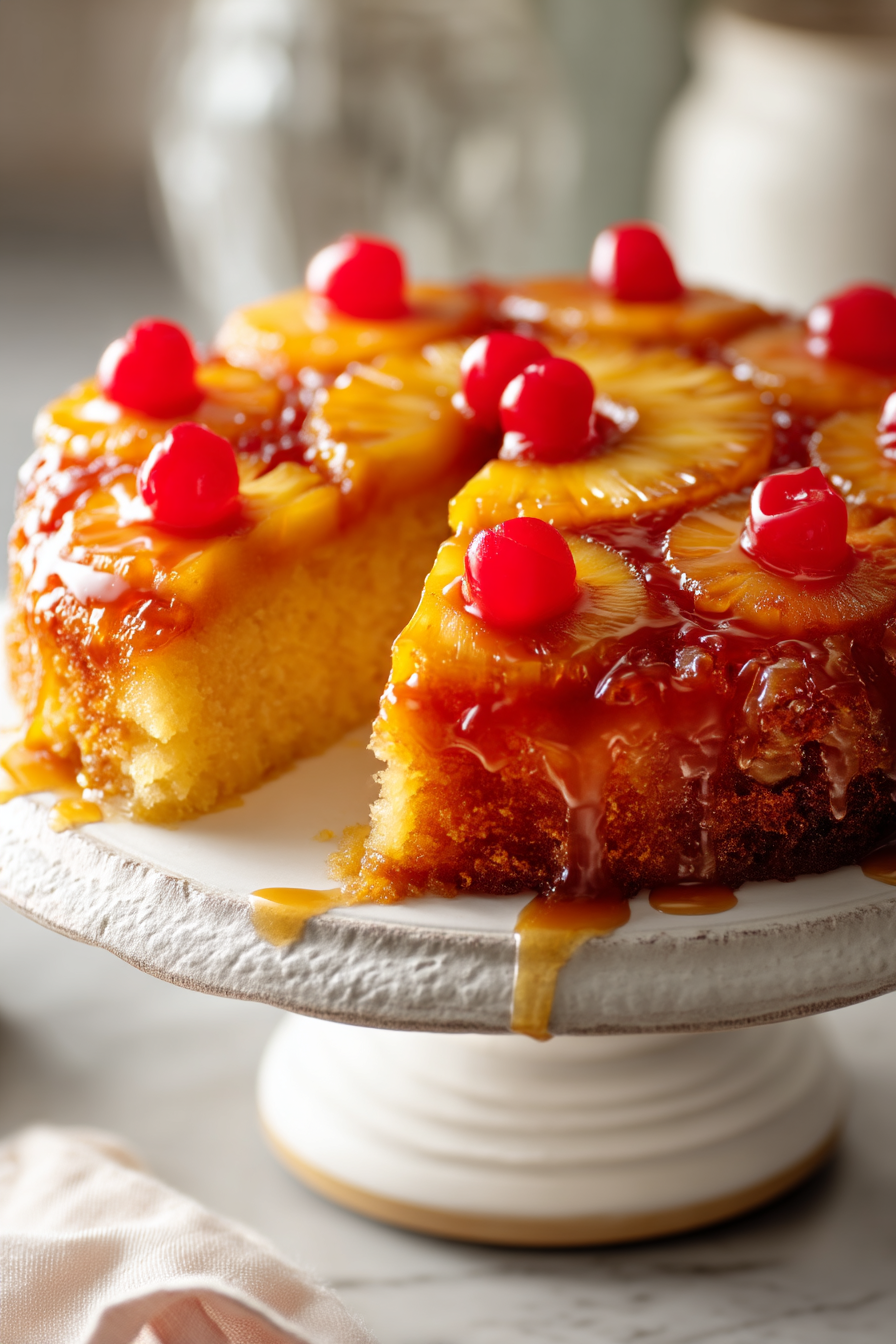
Picture this: a round cake presented on a white ceramic pedestal cake stand with a ribbed base. The entire top of the cake is covered in overlapping concentric rings of caramelized pineapple, each ring stained a deep amber gold from the brown sugar and butter that surrounded them in the pan. In the center of every ring and scattered across the surface, plump, glossy maraschino cherries glow like rubies — scarlet, jewel-bright, bursting with color against the toffee-colored pineapple. One slice has already been removed from the front of the cake, exposing the interior: a warm, honey-yellow crumb, soft and slightly dense, with the caramel glaze seeping down through the cut. The edge of the cake stand is kissed with streams of amber caramel that have dripped over the side during the unmolding. In the background, soft-focus glass vessels add a clean, airy quality to the scene. This is a cake that announces itself.
Nutritional Values for Pineapple Upside Down Cake
Per slice, based on 10 servings:
- Calories: approximately 310 kcal
- Total Fat: 14g (Saturated Fat: 9g)
- Carbohydrates: 44g (Sugars: 30g)
- Protein: 3g
- Sodium: 180mg
- Fiber: 1g
Pineapple upside down cake is an indulgent dessert — rich in butter and sugar — which is precisely why it tastes so magnificent. Pineapple also contributes a dose of vitamin C and manganese, and maraschino cherries add a cheerful pop of color with minimal calories.
Pineapple Upside Down Cake Variations and Substitutions
Fresh Pineapple vs. Canned Pineapple
Canned pineapple rings are the traditional choice and are actually ideal here because their juice is naturally sweeter than fresh. If using fresh pineapple, slice it into ¼-inch rings and blot thoroughly. The results are equally delicious, with a slightly more intense, tart pineapple flavor.
Cast Iron Skillet Version
Melt 4 tablespoons of butter directly in a 10-inch cast iron skillet over medium heat on the stovetop, stir in the brown sugar for 1 minute, arrange the fruit, then pour the batter over the top and transfer the whole skillet to the oven. The cast iron conducts heat beautifully and produces spectacularly caramelized, almost toffee-like edges on the pineapple.
Coconut Pineapple Upside Down Cake
Add ½ cup of sweetened shredded coconut to the brown sugar layer before arranging the pineapple. Use coconut milk in place of regular milk and add ½ teaspoon of coconut extract to the batter. This variation is deeply tropical and extraordinary.
Peach Upside Down Cake
Swap the pineapple rings for thinly sliced fresh or canned peaches. Use the same topping technique. The result is an entirely different — but equally stunning — summer cake.
Mini Individual Cakes
Use a jumbo 6-cup muffin tin and portion the topping and batter into each cup. Bake at 350°F for 20 to 24 minutes. Individual pineapple upside down cakes are show-stopping for dinner parties.
Dairy-Free Version
Replace the butter with a high-quality vegan butter (coconut oil-based brands work best), the sour cream with full-fat coconut yogurt, and the milk with unsweetened coconut milk. The flavor will be slightly different but genuinely delicious.
Food and Drink Pairings for Pineapple Upside Down Cake
This cake is a natural entertainer and pairs beautifully with both beverages and accompaniments:
- Vanilla bean ice cream: The gold standard pairing. A generous scoop of high-quality vanilla ice cream placed beside a warm slice creates one of the great dessert combinations in existence. The cold cream melts into the caramel and pineapple in the most wonderful way.
- Lightly sweetened whipped cream: A cloud of freshly whipped cream, barely sweetened with a teaspoon of powdered sugar, provides a cool, airy contrast to the dense, caramel-rich cake.
- Hot black coffee or café au lait: The bitterness of a strong black coffee cuts through the sweetness of the brown sugar topping and makes each bite taste even more decadent.
- Spiced rum cocktail or piña colada: For adult gatherings, serve this cake alongside a rum-based cocktail. The complementary tropical notes between the pineapple cake and a piña colada are absolutely inspired.
- Sparkling rosé or Moscato d’Asti: The effervescence and slight sweetness of these wines complement the fruit forward character of the cake without overwhelming it.
- Chai tea: A warm cup of spiced chai tea — with its notes of cinnamon, cardamom, and ginger — is a surprisingly perfect match for the caramelized sweetness of pineapple upside down cake.
Presentation Tips for Your Pineapple Upside Down Cake
This cake does not need frosting or decoration — it arrives at the table already dressed in its finest. But a few thoughtful touches elevate it further:
- Always unmold the cake while it is still warm. A cold, fully set caramel can stick to the pan and tear the topping. The 20-minute window after baking is the sweet spot.
- Serve on a white or cream-colored cake stand to let the golden amber tones of the pineapple shine. A dark plate competes; a light plate frames.
- For a restaurant-style finish, drizzle a spoonful of the caramel that accumulated in the pan over the top of the unmolded cake just before serving.
- Garnish with a few fresh mint leaves placed at the center of the topmost pineapple ring for a stunning pop of green against the amber and red.
- At a party, cut the first slice in front of your guests. That moment of the knife going through the caramelized top, revealing the golden crumb beneath, is pure theater.
Storage and Make-Ahead Instructions
Pineapple upside down cake is best enjoyed the day it is baked, ideally while it is still warm or at room temperature. As it sits, the caramel topping continues to seep into the cake, which makes the lower layers progressively more moist and dense. Some people love this effect; others prefer the cake at its lightest on day one.
To store leftovers, cover the cake tightly with plastic wrap or transfer slices to an airtight container. Refrigerate for up to 3 days. Bring slices back to room temperature before serving, or warm individual portions in the microwave for 20 seconds for the best caramel experience.
For make-ahead preparation, you can assemble the topping in the baking pan up to 1 day ahead and keep it refrigerated, tightly covered. The dry ingredients can be pre-measured and kept covered at room temperature. The wet ingredients can be prepared and refrigerated separately. On baking day, let the wet ingredients reach room temperature, then mix, bake, and serve.
Frequently Asked Questions About Pineapple Upside Down Cake
Why did my pineapple upside down cake stick to the pan?
The most common reason is inverting the cake too early. You must wait at least 20 minutes after baking before flipping. Also, do not grease the pan — the butter in the topping provides all the release you need, and a greased pan can actually cause the topping to slip. If a few pieces of pineapple stick to the pan after inverting, simply lift them off with a spoon and press them back into place on the cake.
Can I use all-purpose flour instead of cake flour?
Yes, though the texture will be slightly denser and less tender. If substituting, for every 1 cup of cake flour in the recipe, use ¾ cup plus 2 tablespoons of all-purpose flour sifted with 2 tablespoons of cornstarch. This approximates the lower protein content of cake flour.
Why is my topping too wet and not caramelized?
This happens when the fruit releases too much liquid during baking. The fix is to always blot the pineapple rings and cherries thoroughly with paper towels before placing them in the pan. Excess liquid prevents the brown sugar from caramelizing properly.
Can I freeze pineapple upside down cake?
Individual slices freeze better than the whole cake. Wrap each slice tightly in plastic wrap, then place in a freezer-safe bag. Freeze for up to 3 months. Thaw overnight in the refrigerator or at room temperature for 2 hours. The topping arrangement on a fully frozen and thawed cake can lose some of its visual appeal, so freezing individual slices is the wiser approach.
Can I make this in a 9×13 inch pan?
Yes. Double the topping and the cake batter for a 9×13 pan. Baking time will be similar — check at 40 minutes and tent the foil halfway through. A rectangular pineapple upside down cake is ideal for potlucks and large gatherings.
Why do I use egg whites instead of whole eggs?
Egg yolks add density and fat to a cake batter. Since the pineapple topping already weighs the cake down as it bakes, using only egg whites keeps the crumb lighter and more tender. This is a key difference in this from-scratch recipe compared to older boxed-mix versions.
Notes and Pro Tips for the Best Results
- Blot your fruit — this is non-negotiable. Wet fruit = wet, non-caramelized topping. Paper towels are your friends.
- Refrigerate the topping while you make the batter. This sets the fruit arrangement so nothing moves when you pour the batter.
- Use room temperature ingredients. Cold butter, cold eggs, and cold sour cream will not cream together properly and can result in a lumpy, uneven batter.
- Tent with foil at the halfway point of baking. The sugar-rich topping (which bakes at the bottom) can cause the top surface of the cake to overbrown before the center is done. Foil prevents this.
- Don’t refrigerate the cake to cool it faster. The sudden cold can cause the crumb to seize up and become unpleasantly dense. Cool it at room temperature.
- The 20-minute cooling period before inverting is essential. Shorter and the topping will be too liquid; longer and the caramel can set hard and stick.
Conclusion — A Timeless Recipe Worth Every Minute
There are some recipes that transcend trends, that exist outside of food fashion and seasonal fads, that remain just as beloved as the day they were first invented. Pineapple upside down cake is one of those recipes. It is retro and modern at once, simple yet genuinely impressive, humble in its ingredients but magnificent in its results.
When you set this cake on the table — that caramelized crown of pineapple and cherries gleaming under the light, the amber caramel pooling on the plate around the base — you will see something happen to the people around you. They will stop their conversations. Their eyes will widen. Someone will reach for their phone to take a picture. And then, after the first bite, there will be nothing but contented silence and the sound of forks against plates.
That is the power of a truly great pineapple upside down cake recipe. Now go make it, and make someone’s day extraordinary.